Wertis on the radio

I will be reading a shortened version of the post “A garage so nice you could serve drinks in it” on Writer’s Corner on public radio station WLRH, May 29, 2012.

I am recording more posts in June. Stay tuned!

Readings are archived here and here.

If you like it, please let NPR know.

Posted in WRTS | Tagged , , , , | Leave a comment

The final frontier

When my younger daughter was in first grade they did a unit on space. She wanted a duvet cover with planets and stars on it. For her birthday, I decorated the cupcakes with a space theme. I iced them in navy blue with gold sprinkles and Smarties for the planets. We trekked out to the Greenwich Observatory for a family outing.

“Mommy,” she informed me one morning. “You know how some kids say they like space?”
(No. Is that something kids say? And they’re being insincere?)
“Yes.”
“Well, I really love space.”
Not like those other posers.
“Really?”
“Yes. I love space.”
“That is great. I love that you love space.”

She wasn’t willing to elaborate. I concluded that she loved space in the same way that you and I are in awe of it, in that cliched feeling of amazement that causes you to pause in the driveway and remark, “Look at the stars!” while knowing how lame and inadequate that sounds.

This is why I love this painting she made at a friend’s birthday party. They had just outgrown invite-the-entire-class parties held in vinyl padded play spaces and moved on to invite-all-the-girls (or boys) parties, and what stood out for my daughter was the silliness that orbited the one boy who was there.

I like the way we are out in space looking at the moon and the Earth, seeing, possibly, comets and UFOs, which I don’t think were part of the curriculum. The sun is dwarfed by the moon, rising out of the corner, which shines most brightly, eclipsed only by the part of itself that isn’t there, the three-quarters that exists off of the canvass.

She likes space well enough these days but, like the essential elements of our planet, her love has settled and cooled. I found the painting this weekend when I went on the hunt for picnic things. It was sitting in the back of the cupboard waiting to be rediscovered.

The children from the party have scattered. The garden where they painted, where I can still see them scampering around, belongs to someone else. The party girl lives in NYC. Some stayed in London, some have returned to the States, all following the trajectory of their parents’ careers, or unseen forces that would require the family to embark upon a sparkly new adventure.

“When I am a grown up and I have a house,” the younger daughter prefaces something at dinner last night. Annoyingly, as parents, we qualify for her that she can be an adult and rent.

“When I have a job,” she says.

You’ll have a job to pay rent, we say.

“No, when I have a permanent job,” she says.

“There is no such thing,” I tell her, “as a permanent job.”

But we relent and let her finish the thought and continue in the belief that there is a planet of fully formed adulthood where you will settle at the magic age of 30 with an understanding of yourself as a solid mass and all the rest of it fitted into place.

My husband is outside looking fixedly, not at the stars, but at the roof. ”I am staring at the roof with a mixture of awe and fear,” he says.

We have arrived on that planet of adulthood, a little later than we thought. But who says this will be the last and only planet? That is the fallacy in the notion of a final frontier. It implies both that we have explored and conquered all that there is on Earth, which the bioluminescent, multisexual, superintelligent squid at the bottom of the sea would contradict, and that somewhere amid all of this infinity there will be an endpoint. It is exactly this, the lack of a terminus, that makes me look past the roof, not yet in need of repairs, but with a tree growing out of a gutter that needs to be seen to, and marvel at the darkening sky with the wordless love of a seven-year-old.

Posted in Enjoying nature, Going to a party | Tagged , , | Leave a comment

L’Anniversary

Today marks the second anniversary of this blog. I knew the anniversary was rolling around but I wasn’t expecting it today. Surprise!

I was in the middle of a different post, but I feel I should pause and reflect.

This morning, before it started to rain and thunder, and when the hot sun was already on the rise, I went out for a brief run. I ran past the house where we lived for less than a year when we first arrived. The people who live there now have an enormous boat that they park in the carport that took up so much of the yard. They would have seen that as tremendous asset, whereas we worked around it. We set up our grill under it. The whole thing was slightly graded. We wondered how long it would take and much it would cost to tear up the concrete.

We came back from house hunting, mentally exhausted from all the imagining and trying to clear our heads of the chemical smell of all the scented candles people left burning to cover dog smell. “Maybe we should just stay here,” we’d say, rousing our weary brains to reconfigure the house in our minds’ eyes as our real home. “Maybe.”

Those first months were just a blur of getting bearings.

It was dark and stormy when we arrived from London, but the landlord had left the door open for us. He had set up the mattress we had ordered and bought us a cat box and put litter in it. There was no drama. It was as arranged. Safe, different, strange. Home. Sort of.

I remember opening the sliding door into the inky backyard. “We have outside space.”

The next door neighbor had cancer. She had a carer whose son was called Psalm and a vegetable garden. We saw hummingbirds for the first time. They handed okra, cucumbers and tomatoes over the fence and we returned the containers with cookies.

I never knew where I was driving. My husband navigated, go left, go right, but it took a long time for me to knit it together. I walked to work. We had one car. If I needed to go somewhere during the day, I walked home and got the car. That was three years ago and it seems much longer than that.

At night, we liked that we could hear the trains. It sounded American.

I still like to hear the trains. I noticed the yellow signboard outside of one of the shops on the arterial road had strange messages that didn’t seem to advance the cause of the business it represented. But I was too busy and too confused to think about it.

A year later we had moved into the house we live in now. We got a flyer for the block party. We made friends. I started the blog.

I have friends.

I have started writing again.

I learned how to play tennis. I have teammates.

I have started noticing the signs on the yellow billboard.

Posted in Automotive, Commerce, Driving, Enjoying nature, Flora, Going to a party | Tagged , , , , , , | 5 Comments

Magically delicious

My husband spent last week in London and returned home with treats for everyone. It’s funny how reductive our tastes can be: tea, biscuits, Smarties and the Queen.

There were also requests for Rescue Remedy, a particular facial toner my daughter uses and tea tree oil, all of which I’m sure we could find at the healthy supermarket if we could be bothered to drive for 25 minutes. These were emotional touchpoint requests not deep desires in and of themselves. We miss our old life enough to want some visual reminders.

When we had just moved back, I bought Twinkies. The girls had never had one. It would be educational and I wanted to see if they were still as delicious as I thought they were in my teens. They weren’t. No one liked them.

This story on food Americans miss when abroad includes things which, except for Mexican food and hamburgers, aren’t very good, but they signify home.

Not all bagels in NYC are good. Most aren’t. Favorite place? Brick Lane Beigel Bake, London, their bagels, small and chewy, still warm and filled with cream cheese and lox. And Carmelli’s, a place up in Golders Green, North London, did decent bagels, too. It just takes a while to find what you think you want or need.

That we bring back teabags (and of strong builders’ tea at that) instead of loose tea may indicate a lapse or lack of standards. There is, it turns out, a place downtown that sells freshly roasted coffee beans and a selection of loose tea. That is where we should be shopping. We have known about it the whole time we have lived here but have thought, oh, it won’t be that good, it’s inconvenient, the hours are stupid.  (They don’t open until 9 AM on weekdays!) And maybe so, but if and when we ever move or it closes this will be the kind of place we pine for.

While he was there, I pictured the shops along the street where his hotel was. The things I would have asked for couldn’t have been brought home: the thrill of discovering an obscure book in the Oxfam used book shop, a sausage roll from The Ginger Pig, smelling soaps in Ortigia, the beautiful packaging of Rococo chocolates (I will ask for a tea towel next time), browsing for ribbon for my work ID badge in V. V. Rouleaux, getting picnic provisions at Waitrose and passing from a summer street into the coolness of a park in an ancient city.

The older daughter asked for Smarties, but what she really wanted him to do was ride the new Metropolitan Line, which she has seen on YouTube, and tell her about it. Even for me, the irritants of tube travel, the repetition, the black snot formed by breathing particles of burnt rubber train wheels, the Metro and its sensationalist headlines, the arrival at your stop, the series of escalator journeys up towards Big Ben that was a stage in my commute, become the stuff of dreams.

Posted in Blighty, Commerce, Enjoying nature, Flora, London, Regional variations, Shopping, Travel, Traveling | Tagged , , , , , , | Leave a comment

The new world

On the first day of third grade, the children found their teachers on the multicolored playground. The younger daughter’s class assembled by the carved wooden owl and they formed a line, a skill not practiced over the summer. They were gangly, tan and full of bounce, with jack-o-lantern smiles, new Crocs and T-shirts from summer places. The annual reshuffle of personalities reconfigured by class list and peppered by new kids.

I watched in horror and fascination as one of her classmates, a new boy in fashion-forward skate punk clothing and a hairstyle, who reeked of ennui, whipped out an iPhone and began day trading or organizing his holiday snaps as the class marched into the building and all that lay before them as a new school year began.

Just as swiftly, one of the teachers, plucked it from his hands and said he could have it back at the end of the day.

I breathed a sigh of relief.

Fast forward a couple of years and my daughter bemoans the fact that she does not have a phone. And not just a phone, but an iPhone. Until recently, she was the only girl in her class who did not have pierced ears, now she lacks a data plan.

Parenting is like standing on the shore as the tide laps at your feet. Requests are made and denied, wishes granted, desires are satisfied and recede. You watch the waves come in and roll out. Some kind of balance is achieved but all the while the tide moves up or back. You try to not let your feet become implanted in the sand nor let the waves knock you down.

Or maybe parenting is being a storm chaser. Or a sailor. It is essentially a person and nature situation. The navigational strategies are the nurture components.

In 2008, a third grader with an iPhone was extreme and ridiculous but very quickly the kids would catch up and it was neither. In fifth grade it was all about apps. And she still didn’t have a phone, not even one of those prepay ones “for emergencies” that parents used to get their kids when they were afraid they might get mugged. We upgraded her iPod shuffle to an iPod touch so she could have a camera, do email, have music and a few apps, but, really, a phone? Why?

Now 12, she still thinks we should get her a phone, but more often she comes home with stories of how she has been with friends who have spent the whole time texting each other and not talking. Twice a week she helps out with the morning drop-off at school, unloading little kids from cars and making sure they get into the building safely. Often there are screens in the cars, handheld or mounted on the seatbacks. People not talking. Bags of drive-thru breakfast on the seat.

She is like the only sober person at a party of drunks. Part of her just wants what everyone else has and doesn’t want to be left out, but she is also able to see how sometimes everyone has gone a bit mad, that the dream they’re chasing is, you know, not so great. Now that she has email, she has junk mail.

Yesterday she gets her hands on a device and texts me. I am standing in the room with her. Hello, she texts me. Hey. Then, check ur messages. Then, Repli. Then, Ur phone is making mad noises.

Child, I say, stop doing that.

I remember taking a paracetamol tablet after a year of abstaining from any type of substance during pregnancy. As the drug hit my veins and dissolved my headache, I felt like a character in a Hubert Selby Jr. novel.

The other day I was driving the younger daughter and two friends. It was a 10-minute trip. “Finish telling your story,” one says. Apparently, they had started stories at school and so she picks it up, from out of her head, and spins it. It’s her story, so I won’t retell it, but it’s actually rather good. When we get to our destination, we sit in the car as she closes a scene. The friends say, “it’s really good.” “It’s like a real story.” I wait until they are out of the car so I won’t embarrass her before I concur.

When she was little, she had inventions, but said she was keeping them in her head so no one would steal them. Every now and then, I would suggest that she write them down so that she wouldn’t forget them, because that would be terrible, to be haunted by the ghost of a memory of a great idea.

And this is what it’s like as they grow up, they have these strengths that blossom when you least expect it. Eventually, she will need a phone so that she can call her executive car service to pick her up from the pool, and that day will come, but there is something worthwhile to be gained from the clarity of her observations that I hope she won’t forget as the wind draws her into the vortex of whatever storm is brewing.

Photo taken at the Smithsonian by the younger daughter, July 2011.

Posted in America, Automotive, Folkways | Tagged , , , , , , | 3 Comments

How do I work this?

Since in America you are what you consume, here’s a self-portrait. The dominant colors are green and orange. I buy in pairs. They don’t do 3-for-2 specials here. Because we hardly ever do the weekly shop at either of these stores, it was a sort of skewed one that anticipates the departure of my husband on a business trip and a meal plan that read Wintzell’s for one night (but then we stayed home and grilled chicken) and babysitter another, the rest left to chance, marinade and the magic of the slow cooker. I was thinking a lot about packed lunches, too. Packed lunches and breakfasts.

When I returned home and set out my purchases my husband’s comment was “you didn’t buy enough food,” but I think this will get us through the week.

I showed him the mojo sauce, which will extend the chicken into a second meal. The first supermarket is crazy expensive. They blast classical music along with the air conditioning, which feels to me like the display of haughty airs of a waiter at a fancy restaurant or a country club in a 70s sitcom, where the protagonist is first cowed and then, provoked by some snobbish moral breach, later able to assert his true, down-to-earth character and values, reject unpronounceable delicacies, throw down the starched napkin and either order beer, ask for ketchup or leave in a huff, announcing his intention to go enjoy a brontosaurus burger at the drive-in. Other patrons sniff and daintily return to the food while the waiter shudders in disgust and the management howls “…and never come back,” to which our hero rejoins, “don’t worry, I won’t!” and the studio audience applauds madly.

I do however appreciate this supermarket’s dedication to the finer things when it comes to  chicken, which is what takes me there. My colleague has been recommending a particular brand of bacon so I take a pack. Beans have better graphics, less sodium and are on offer for $1 per tin, but then I’m trying to remember what they charge for beans at Kroger, 86 cents? $1.03? But the music is so elegant. Two pears. Total $32. (The chicken is nearly $10, but totally worth it.)

I would add that this is also a place where they make elaborate displays out of the seasonal Peeps (sugar-coated marshmallow shapes) now produced for any occasion that resembles a holiday, not just for Easter anymore, a yearlong rotation of Mike and Ikes and Dots and other candy change along with them so that one walks past this display, in recalibrated hues—irony or just smart marketing? Both!—on the way to the cheese counter, Vivaldi blaring.

Lurpak butter, yay, and chorizo. A pack of somewhat healthy looking chicken tenders/fingers. Lunchbox snacks: cereal bars, “fruit chews,” made from “natural” ingredients (candy you can eat in school). Frozen berries that haven’t been treated with anything. Other items: seeds to grow basil and catnip, which I hear repels mosquitoes, hair elastics, needles and pins, cotton balls, Snoopy stickers.

I buy broccoli, a red onion, spring onions, carrots and some rose garlic from Mexico. (Click the link, it’s a great recipe.)

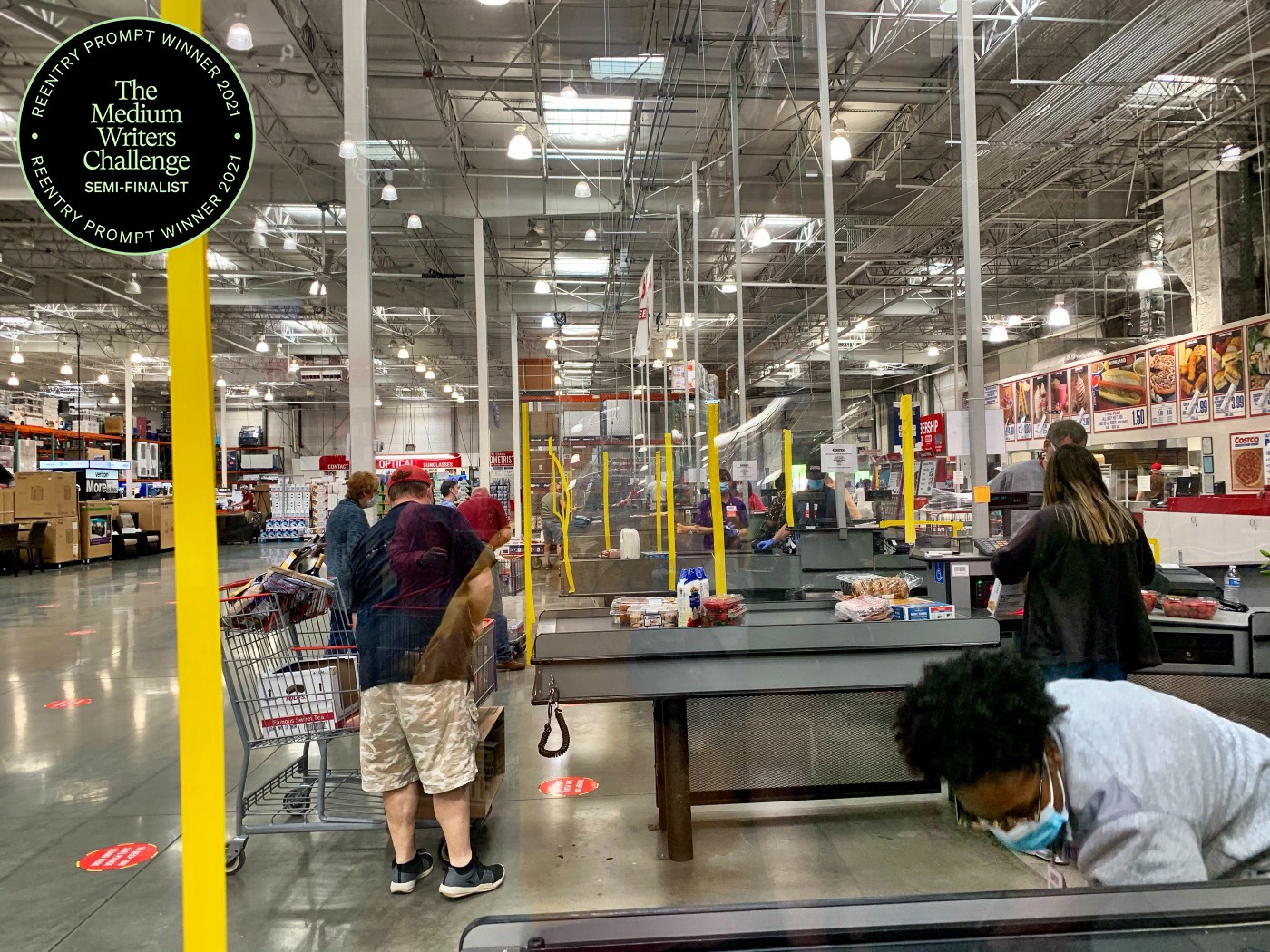
I photograph the groceries on the conveyor belt as I get the idea that this is a snapshot of a state of mind, and of having settled in, but also not totally acquiescing to the amazing amount of products and non-food “food” on offer. A portrait that mingles need with desire.

Photographing your own groceries at the store is like announcing that you are insane.

I have stopped beating myself up about not being able to find my car in the parking lot. Cars all look pretty much the same. You can ask my friend Mia. Unable to distinguish one beige sedan from another I locked my bridesmaid dress for her wedding in the wrong car. When we returned to the car where I had done this, she cried incredulously, “You thought this was my car? This looks nothing like my car!”

On closer inspection it was seedy and beat-up. There were some Herbalife brochures and product displays on the seat, cigarettes in the ashtray, tsotchkes on the dash. Fortunately the owner returned and was understanding about our attempt to retrieve the dress with a coat hanger pushed through the gap in a window.

It is certain that this is my car. There is a spray of red dirt against the front fender from some truck in front of me the other day and lying on the seat are the elaborate directions I print out when  I need to take an unfamiliar route.

I’m sure the chain-smoking Herbalife saleswoman in Seattle has these moments, too. Standing in front of a sleek, taupe, maybe Mercedes sedan, smoothing her hair in the wind, seeing herself in the tinted glass, wondering if her key will open the door.

I sit in the car with my purchases, my idea of the week ahead, my hopes for it, the balm of the stocked pantry, the promise of industrious kitchen arts. The pears are the first to go.

Posted in Automotive, Commerce, Cuisine, Helping at home, Shopping | Tagged , , , , , , | 1 Comment

Missing

May 1979 something shifted with the disappearance of Etan Patz, a boy whose name you may not have known or may have only dimly recalled until yesterday when he was once again front page news in the New York Times.

Flyers appeared all over the neighborhood. His face in black and white. Son of Sam wanted. Etan Patz missing.

A 6-year-old boy on his way to the bus stop disappears. He is never found. There is no ransom note. There are no motives. No one saw anything. I remember finding the story awful and sad, but at the age of 12 I did not feel myself any less safe. He was a little kid. I had already crossed into the realm of independent travel. I had a train pass, a house key, and the wherewithal, so I believed, to spot trouble and cross the street, and the maturity not throw a Superball onto the third rail to see it sizzle.

Trouble was the man who tried to drag my friend into the divey SRO hotel, off Washington Square Park, at the corner of our two streets. The hotel was a place where the residents kept their milk and grape soda on the window ledge in winter to keep cold. What they did in summer, I don’t know. She fought him off. Trouble was pushers (no one uses that word anymore, do they?) in the park or a group of winos (who was to say they were homeless? Just local, capable of  boozy sentimentality or sudden rage, who knew?) on your stoop. The ranting man who rifled the trash cans at the corner, stuffing things into the pockets of the greatcoat he wore, year round, he was probably homeless. It wasn’t a word we used then. Trouble was a shocking story of some boys from my school who were abducted and traumatized in downtown Brooklyn. My mother refused to tell me their names so they remained shadowy and allegorical, part of a dangerous landscape that I would survive.

At 12 I felt invulnerable, neither a small defenseless child nor a woman, I did not fall into the victim category for Son of Sam or Etan Patz’s abductor. And because teenagers believe they are immortal anyway I accepted that the city had its perils but that life went on.

Unless of course it didn’t.

But I think it was different for the younger children and for their parents. Even if my mother had wanted to never let me out of sight at that point, it was too late. I was already out there. But for younger children, hanging out on stoops, going with a friend to the Good Humor cart, near the park, with the vagrants and the winos and the pushers, maybe no longer seemed like a risk parents were willing to accept.

With no explanation for the crime it could be anything you imagined.

Two things struck me reading the article in yesterday’s paper.

1) The image of them excavating the past as they tear up the concrete looking for the body. That in 30+ years, SoHo has so utterly transformed from what it was then to what it is now. If you didn’t live it, it must be hard to imagine that there were outposts in Manhattan that were silent on the weekends, where you’d have to walk for blocks to find a place to buy milk or some coffee in a styrofoam cup. SoHo, Tribeca, Union Square could be desolate. They are digging into the past, recalling a bygone era.

2) While all of this time and change has taken place since that day in 1979, and we can imagine its significance, and reimagine the unsolved mystery, and theorize about its impact on society as a whole, for the parents, it probably can feel like yesterday and it is probably just about their son and irreconcilable loss. They were unavailable for comment.

Posted in Being mortal | Tagged , , , , | 8 Comments

The Biscuit Tin

Night is falling. We are sitting in our friends’ back yard watching their next door neighbor light a bonfire for our children to tend. His are at the beach with his wife. Since the storms last year, the bonfire has been a popular activity.

Our friends’ German house guests call to report a flat tire, but the evening is fluid, dinner safe to wait. It is a perfect night to sit outside. Fireflies, but not mosquitoes. The children gather sticks and organize themselves.

The neighbor hands me his phone with a picture of his younger son in the dark, in front of a rectangular fire.

“Forget Chuck E. Cheese,” he says. “For X’s 10th birthday, we had all his friends over and burned down the climbing frame.” It’s brilliant, the perfect party for 10-year-old boys: a tribal fire ceremony, a little danger, a rite of passage and much more fun than spending part of your weekend dismantling it with tools.

The house guests return. The children come back through the fence in search of food.

We had a bonfire night in college on the eve of commencement. All the seniors would drag their old furniture out of the campus apartments and burn it. Textbooks that should have been resold to the book co-op were lobbed into the fire. Handfuls of paper were carried up into the flames. My friend’s notes from accounting, papers, papers, symbolism, papers about symbolism.

My younger daughter has never liked these transitions, leaving the crib, the high chair, the pushchair, the training wheels. Maybe instead of selling her crib on Craig’s List to a lady surprised by a late baby long after she had shed her children’s baby things we should have taken it out to the communal garden and torched it.

In the weird late pregnancy days with my first child, I had somehow ended up with this mother in my flat. She was selling something baby-related, possibly stationery for birth announcements? It was before the internet became a marketplace. If you wanted to buy certain things you had to go to shops or make phone calls and talk to people. Somehow this has led to her sitting in my living room telling me how badly she wished she were pregnant again.

Her doctor had told her another baby would kill her. She was already a mother of 10. I filled two pages of my baby journal, describing this odd meeting, knowing then that what my unborn child would find interesting about the days leading up to her birth was probably not this. Sorry! I am your mother and I am flawed.

Otherwise, I was alone for a week or two of maternity leave, waiting for the baby, not knowing what else to do, tearing through the works of Olivia Manning and re-reading all of Updike’s Rabbit books (note to expectant mothers, not a good choice; women, especially mothers, are very unfavorably portrayed) and wondering how else I could prepare for this unavoidable, unimaginable event; waiting on a guest who is late and will not let you know at all when to expect them, only that he or she is coming, not like the German house guests who called with a revised ETA once the flat was fixed.

All the while, the mothers from our National Childbirth Trust class were having their babies and word was passed along. Then we would reassemble and drink tea on each others’ floors while watching babies sleep or tending fuss. The health visitor is giving a talk about sleep. The friend of a friend is leading a postpartum exercise class. The women’s club is having a social.

I thought in the months that followed that if I were ever to write the story of my London motherhood years it would be called “The Biscuit Tin,” for this would inevitably make the rounds at every gathering of mums. It would be my homage to The Bell Jar—American Sylvia Plath’s own days of early North London motherhood and then suicide—took place not far from where we lived.

I passed by Plath’s last house, blue plaqued, every day on the way to some holiday art camp, and then again to a play center, killing time with an infant between drop-off and pick-up of a toddler. I realized that you, as a mother, could narrate your own state of mind, spending so much time alone or in your head. It is the doing for, the mental calculation of naps and meals, that fills your thoughts along with nursery rhymes and action songs from playgroup. If you keep telling yourself you are unhappy, it is a refrain that it works its way into the rhythm of the day and you become so even more.

From Primrose Hill you can see the bird enclosure of the London Zoo, a high, trapezoidal  cage rising up at the edge of Regent’s Park. There used to be a wolf in an enclosure along the Broad Walk and a few years later, after reading Lucy and the Big Bad Wolf, where the wolf escapes from the zoo and ends up in a suburban a housing estate, we went to visit it, but they had rearranged the animals. Our zoo membership days were past so we were not going to spend £20 on admission to go in looking for it. A harder line had been drawn between real life and the zoo, no longer the wild animal regarding you on the other side of  the low stone wall that separated your park from his. Another childhood haunt left behind.

As a mother, each letting go of childhood equipment was liberation: both for the child who could sit unaided and the mother who no longer needed specialty furniture. You sell, you pass along to friends. Or you celebrate its obsolescence. You burn it down.

The neighbor hands the German guest an anti-Auburn bumper sticker to put on his car when he gets home. He grins with the pleasure of sending a message onto unknown roads, of just knowing it’s out there, scoring one for Alabama.

Darkness, a fire smouldering. The children just being children. The biscuit tin years felt endless but of course were fleeting. Enjoy your 10 children and don’t mourn the 11th that will never be. Take notes. Know when to burn them.

post scriptum:

Searching online for a picture of Plath’s blue plaque, I found this article. Proximity to the zoo meant that Plath and Hughes could hear the animals, and the wolves.

Photo by Older Daughter, Violet Hill Gardens, London, 2011

Posted in Alabama, Going to a party, Helping at home, London | Tagged , , , | 8 Comments

Star attraction is pants

“You have to write about it,” my husband agrees, “but you must make it absolutely clear that it was not our destination. We were on our way to somewhere else.”

I can’t say that I hadn’t been tempted by my colleague’s tales of designer clothes going for a song or our friends’ house guest’s recent purchase of a portable DVD player for $40, but it was only because we were going to Chattanooga that we decided to stop in and see what it was all about. As a New Yorker and a Londoner who has never been to the Statue of Liberty or the Albert Hall, I am capable of living in a place and ignoring, even avoiding, its star attractions.

Initially, the idea of the Unclaimed Baggage Center captured my imagination. We heard about it shortly after we moved here. This was the place where unclaimed bags from airports all around the world ended up. A major tourist destination in North Alabama, UBC was the second place in the state to have a Starbucks.

UBC's founder Doyle Owens and wife Sue

The idea is compelling. What do people pack? What would you find?

This is the interest factor in shows like Storage Wars. A bag is revealing in the way that a person’s shopping on the supermarket conveyor belt provides a speculative ramble about another life. It is socially acceptable snooping.

But there is something fundamentally morbid about an unclaimed bag or an abandoned storage locker. Have you noticed that Barry Weiss wears black gloves with skeleton bones when he unpacks the lockers on Storage Wars? It’s grim reapery to be picking through the remains of a life, even if it is only the little sampling of a life that was, as we were when we stopped in, on the way to somewhere else.

The Unclaimed Baggage Center does the Barry Weiss skeleton glove work themselves, unpacking, cleaning and sorting all of the contents so that there is a department store/charity shop format and no smelly surprises, not the mystery bag auction I thought it was when we first heard about it.

Did you leave your book or your reading glasses on the plane? There is a whole section of reading glasses, a monument to forgetfulness, shelves of books, a case of bibles. There are racks of unclaimed sidewalk art, a display of all the headphones found at the bottom of seat back pockets, each one in a plastic bag. This place conjures up the discomfort and transience of air travel, the confinement, the unwanted physical proximity to others, the hand that pushes on your seatback and inadvertently pulls your hair, other people’s ears, salted nuts.

The only items that seem not to have made the cut are toiletries, except the barely used bottles of perfume encased in the jewelry section, a spritz of hope, the joy of duty free, a week going out for dinner. But underwear did. The lives this collection of goods represents no longer intrigue me. There is no poetry here. I know too much. Spirit, take me away! I didn’t even check the prices on these large white ladies underpants, but honestly, how much of a bargain would they have to be for you to buy them? This makes Kirkland lingerie seem like a luxury item. Nor did I check the label on this bondage-inspired designer bodysuit. I was desperate at this point to be on my way, headed somewhere else, anywhere but here.

Posted in America, Driving, Shopping, Travel | Tagged , , , , , , | 2 Comments

Cult fiction: Exclusive interview with reclusive authoress

The Wertis is delighted to present an exclusive interview with author Rebecca Moore, who after publishing a number of stories in alternative teen magazine Sassy and getting taken to a few lunches and coffees with editors, disappeared off the face of the earth, never to be heard from again. Until now.

We meet for a casual breakfast of homemade waffles. We are intermittently interrupted by the dog ringing his bell to go outside and the low hum of ongoing demands of morning in a household with children, hers, mine.

Moore published Lunch in Brooklyn, a novel she wrote as her MFA thesis at Columbia University.  The novel was excerpted in a three-part serial in Sassy in 1993-94. Moore was thrilled to receive letters from readers who had connected with the stories.

“As a writer,” she says, “it is an amazing feeling to connect with readers, even more amazing when your readers are writing for permission to reprint your words on a T-shirt.”

Moore was initially hopeful that the book would find a publisher, but it did not, which was sad.

A year later, Moore and her husband moved to London. Her life shifted, she lost confidence in her voice, had children, lacked time. But over the past few years, Moore has discovered online queries, including this blog post, and has been contacted by other Sassy readers as to the fate and availability of the book. She decided to shake the dust off the manuscript and toss it out into the world.

“With the emergence of online publishing, I thought it was better for the book to become available than for it to continue to languish in a box, just another mystery for my daughters to contemplate after my eventual demise.”

That was cheerful. Thanks. What inspired the book?

“The book started out as a couple of different stories,” she says. “One was entitled ’8th Grade’ about girls behaving badly over the course of an unsupervised weekend, which is now the chapter of the book called Fifth Hex. I was trying to capture that weird edge of pushing against the boundaries of what you could do in the absence of parental supervision, a brush with danger, the sense girls that age have of wanting to be noticed and that feeling of immunity to real danger, the way you do things just to have done them.

“Another story was based on a tradition we had in middle school where at the end of the year the 8th graders would write a last will and testament and hand something down to a 7th grader to have in 8th grade. My friend who was moving up bequeathed me her bubblegum chain, which was something like 10 feet long and had in it gum wrappers that probably went back to when we were in lower school. There was a poignancy in that that I wanted to express, how we were shedding our childhoods and stepping forward into adolescence.

“The strange thing about the late 70s,” she continues, “was that it was a time when all of the grown-ups were having a second adolescence. Popular culture was rife with sex and drug jokes and self-actualization. It was like massive sort-of California-oriented era. Another thing I wanted to capture was the disconnect between the nurturing, empathic quality of my school with the snake-pit atmosphere we students could impose on each other. What was up with that? I thought I was the only one who felt that way, but when Facebook came along people shared all sorts of memories and reactions to those days that surprised me.”

What were you like in Middle School? Were you like Kate?

“I was sensitive to other peoples’ opinions of me, but less concerned with the idea of popularity, and less popular in the clicky sense, but I also had a more diverse and interesting group of friends. I don’t think I categorized people the way she did. But I do remember being kind of down in 8th grade and not feeling particularly connected.

“I reconnected with a middle school friend a few years ago. In the exchange of life stories she said that she had thought of me recently because her son, then a 9th grader ‘had writing on his shoes – messages from friends – and I was recalling that I had this friend in Middle School who wrote on her jeans; that it was kind of a thing to do then … You wrote this thing I have thought about a few times over the years, don’t know why: God is alive and well and signing bibles at Brentano’s. Pretty advanced for an 8th grader!’”

Moore laughs. “It’s funny because of all the stuff I dredged out of my memory about the kinds of stuff we did, I had forgotten about writing on jeans. I don’t even remember that as the kind of thing I would have written. When I think of myself at that age I feel a general sense of ugh. Even when we think of ourselves at that age we lack some kind of basic perspective that I hope we all gain as we get older, but maybe not about our young teen selves. We have this rigid way of perceiving ourselves, even in retrospect, that does not take into account other viewpoints or possibilities and so does not allow us the sense of capacity for change, which of course is tragic and ridiculous. We see what matters most at that moment. That was the sense I trying to convey at the end of the book, when Kate leaves school for the last time, she has the idea that memories solidify into something fossilized.”

It is time to drive the younger daughter to the pool so we conclude our interview. Moore says that she would be happy to continue the conversation another time. You can find her at her blog, Lunch in Brooklyn. The book is published in a variety of digital formats and can be purchased on Amazon or at Smashwords.

Posted in Being mortal, Commerce, Going to a party, New York City | Tagged , , , , | 3 Comments